Archery tool
FOC Calculator
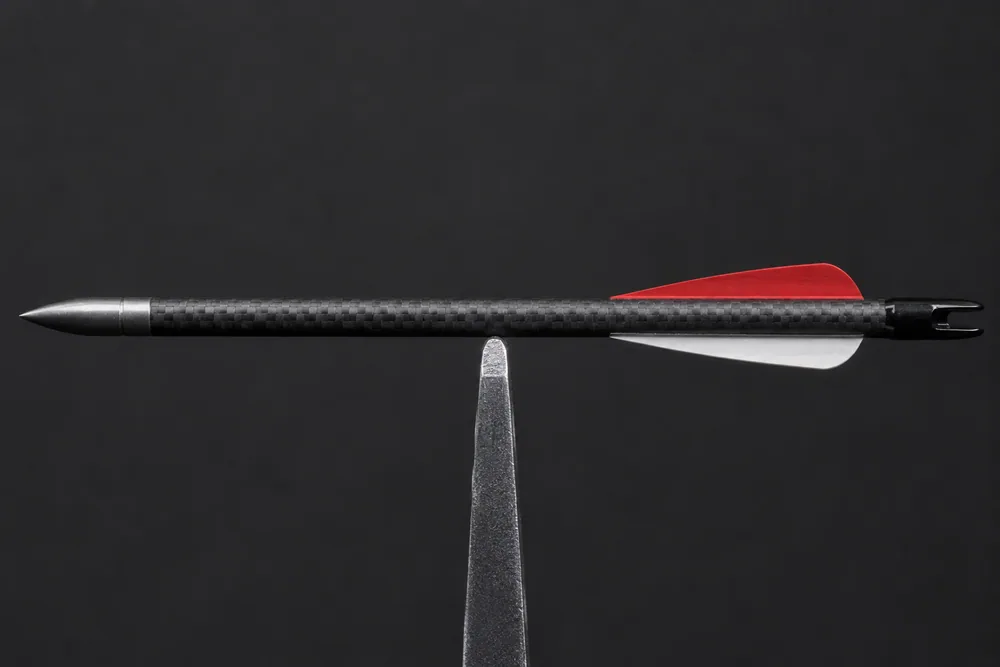
This calculator works out an arrow’s FOC (front of center) — the percentage of its length by which the balance point sits ahead of the arrow’s physical middle. Enter your arrow length and its balance point (measured from the throat of the nock), and it returns FOC% using the standard formula: FOC% = ((balance point − (arrow length ÷ 2)) ÷ arrow length) × 100.
Calculate your FOC
Enter your arrow length and balance point above to see your FOC. With JavaScript turned off, use the formula below to work it out by hand.
The formula, shown
FOC is a simple, standard calculation — there’s nothing proprietary about it, so here it is in full:
- Measure the arrow’s overall length (L), in inches.
- Find the physical center of the arrow: L ÷ 2.
- Balance the finished arrow and measure the balance point (B) from the throat of the nock, in inches.
- Subtract the center from the balance point: B − (L ÷ 2). This is how far forward of center the arrow balances.
- Divide that by the arrow length and multiply by 100: FOC% = ((B − (L ÷ 2)) ÷ L) × 100.
Worked example: a 29-inch arrow that balances 16 inches from the throat of the nock has a center at 14.5 inches, so it balances 1.5 inches forward of center. FOC = (1.5 ÷ 29) × 100 = 5.2% (rounded to one decimal). You can check that result in the calculator above.
What FOC is and why it matters
FOC, or front of center, describes how front-heavy an arrow is: it is the percentage of the arrow’s total length by which its balance point sits forward of the physical center. A higher FOC means more of the arrow’s weight is concentrated toward the point.
That balance affects how the arrow flies. Higher FOC generally improves forgiveness and downrange stability — the arrow tends to recover from the bow and steer more reliably in flight — but it lowers and steepens the trajectory, because weight moves forward and overall speed drops. Lower FOC flattens trajectory and can feel faster, at some cost to stability. Archers tune FOC by changing point weight, insert weight, and shaft choice to trade accuracy against speed for their distance and discipline.
Ready to build an arrow with that FOC target? Shop arrows and components and confirm the final setup with a coach.